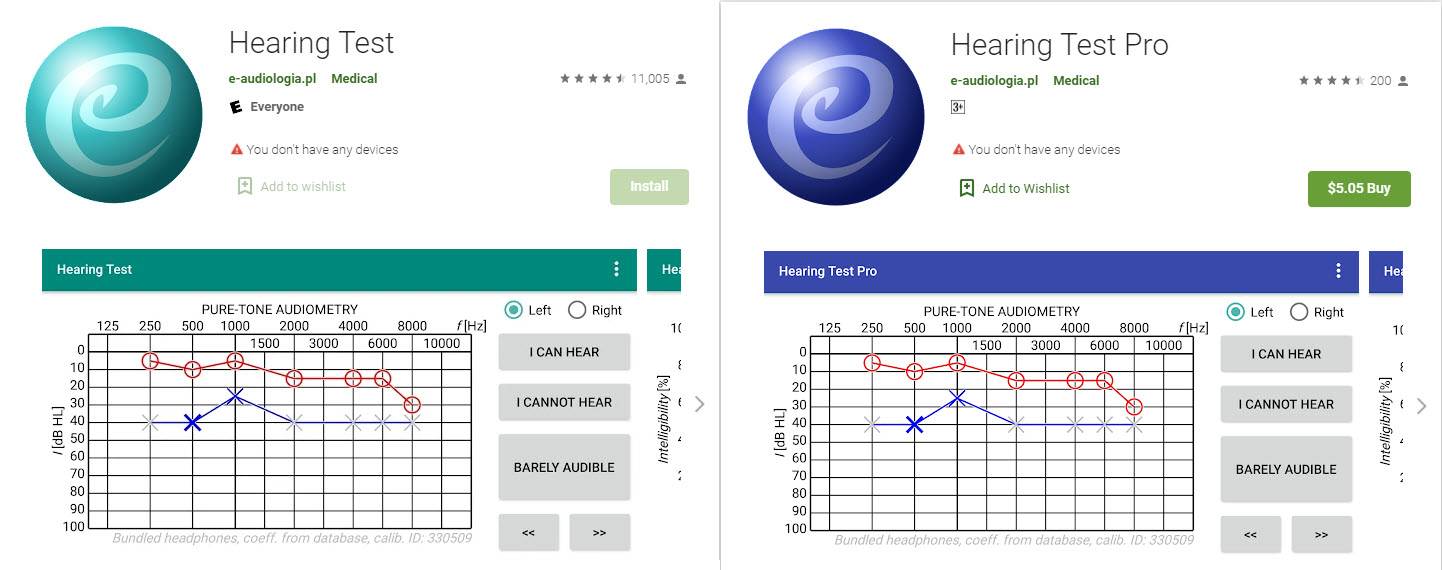
App Summary
The app provides two basic hearing tests: pure-tone audiometry (PTA) and the speech intelligibility test (the digits-in-noise, or DIN). It has two versions, Standard and Pro, this article evaluates the Standard version. The standard version has 11005 reviews out of 1,000,000+ users. The Pro version has 200 reviews out of 1000+ users. They are rated 4.5/5 and 4.4/5 respectively.
It is an app developed by Information Technology in Medicine Medical Practice Marcin MasaLski. Its located in: Gwiaździsta 23/1 m.2, 55-010 Radwanice, PL.
Captured Understandings
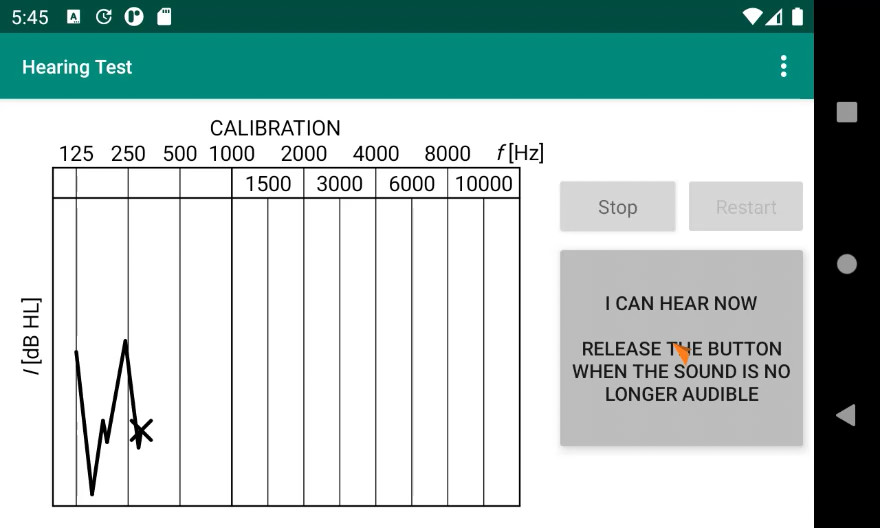
Before using it, a user has to ask someone who has good hearing to calibrate the app. The calibration lasts for at least 7 minutes. It has to be done by a person who has no hearing issues. To avoid calibration, a user can use Bundled headphones, which requires another purchase.
During the calibration, a constant beeping starts from 125hz and slowly goes across various frequencies non-linearly to 10000hz. It requires the calibrator to press and hold a button ” I can hear now” as long as s/he can hear the beeping. When the button is pressed, the volume goes up, otherwise, the volume goes down.
It draws a boundary of volume parameters for different frequencies. In terms of data logging, it records a volume value for each frequency across the entire range.
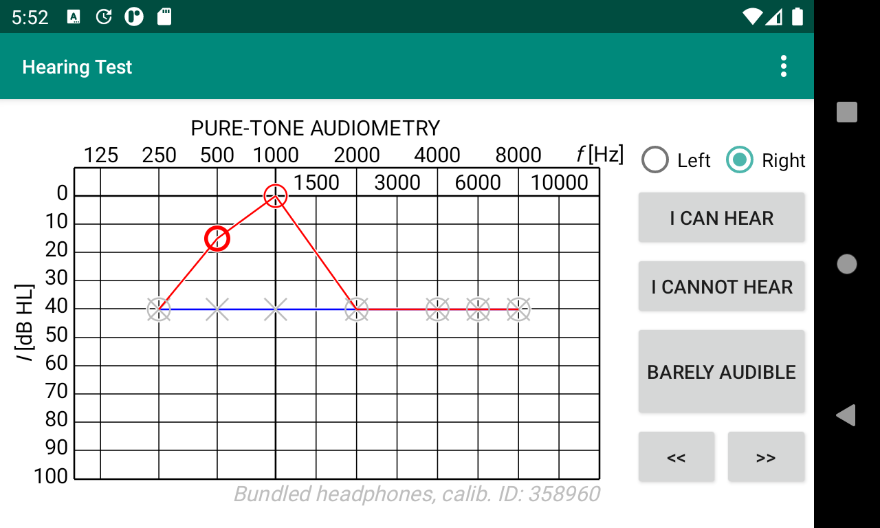
A PTA test picks up seven frequencies, namely 250hz, 500hz, 1000hz, 2000hz, 4000hz, 6000hz and 8000hz. It tries to test the volume at different frequencies for both ears separately.
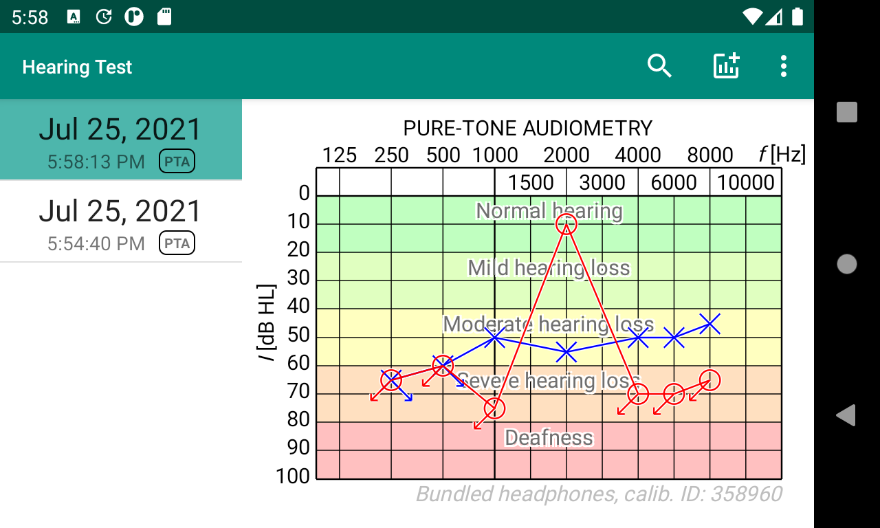
Hearing results are then compared with a preset range with 5 bands,
- Normal
- Mild hearing loss
- Moderate hearing loss
- Severe hearing loss
- Deafness.
Each hearing test is associated with a calibration ID. Both figures 3 and 4 refer to Calibration ID 358960.
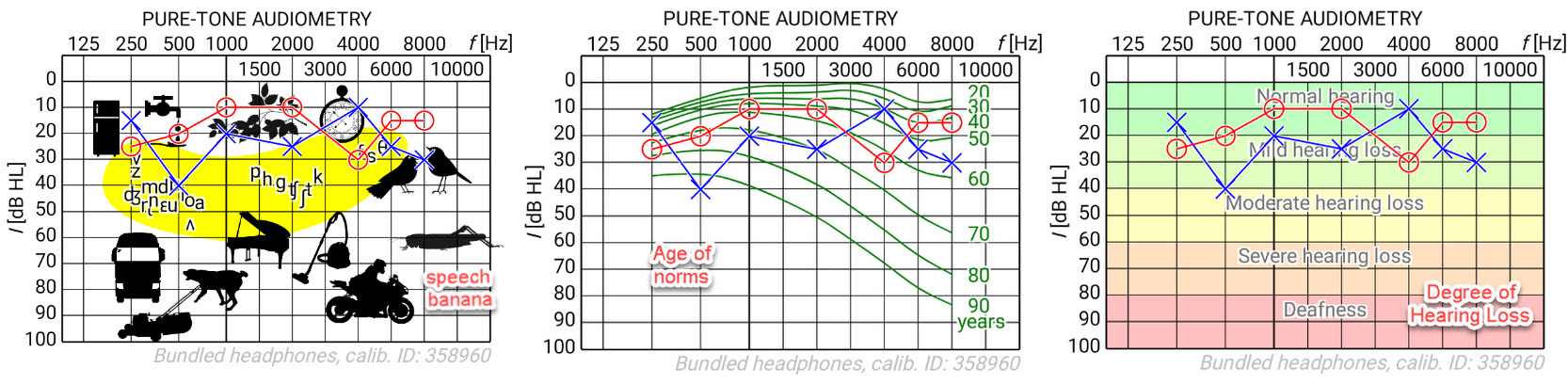
It has three types of interpretations, as shown in Figure 5
- Degrees of hearing loss
- Age norms
- Speech banana
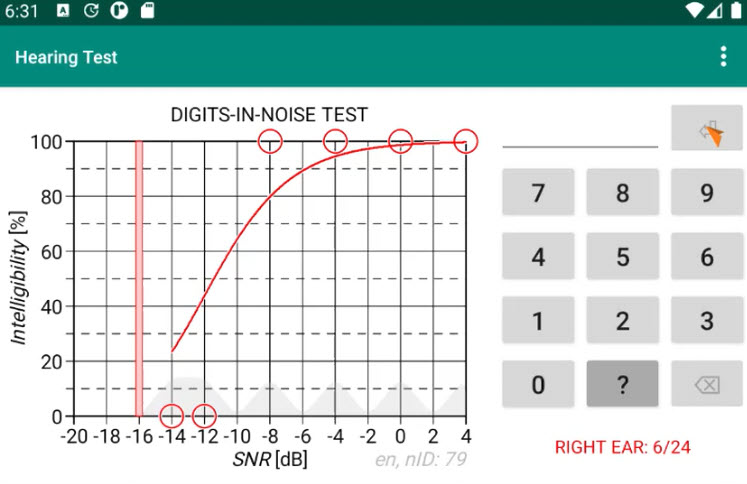
A digits-in-noise (DIN) test for speech intelligibility measures a user’s capability to identify a meaning sound from a given background noise. In scientific terms it measures the user’s capability in different SNR (signal-to-noise-ratio).
During a DIN test, it checks a listeners capability to identify 3 digits in various SNRs, and intelligibility is calculated based on the accuracy of the answers. There are 24 tests for each ear, and it starts from the clearest SNR, i.e. 4dB. If the user successfully identified 3 digits, it moves to a lower SNR. In other words, it becomes harder and harder to hear as the noise become more and more dominant. If the user missed 1 or 2 digits the SNR tunes a little bigger. Otherwise, it goes a little smaller.
Normally the test goes back and forth at the lower SNR where the user tends to make more and more mistakes.
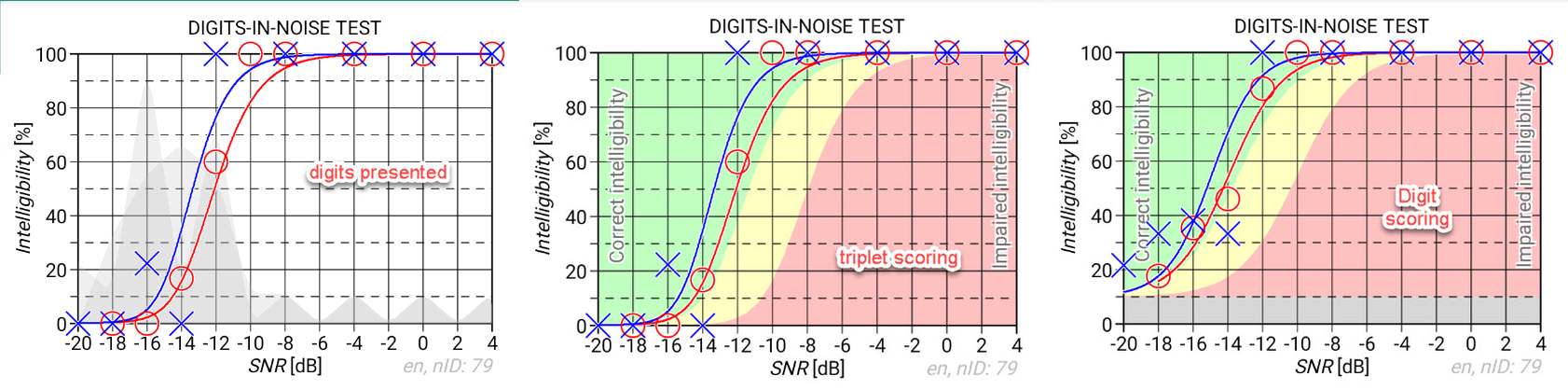
There are three types of presentations of the final results, as shown in Figure 8:
- Norms, digit scoring
- Norms, triplet scoring
- Number of digits presented
| Parameter | Value | Remarks |
| Version | 2.0.24 | Standard |
| Size | 4.4MB | Compiled Size |
| Device | Nexus 4 | AVD |
| Screen | 768×1020 | |
| API level | 30 | |
| Screen Capture | Yes | |
| Calbiration | Performed | in-App |
| Tests performed | 16 | |
| Crash | 0 | |
| Screen Layout | Landscape,portrait | forced by app |
- As an amateur user, the App is considered easy to use. (not for elderly people)
- The parameters and tests are easy to understand.
- Flow is intuitive and conforms to Android standards.
Questions
What is speech banana? Do we need it?
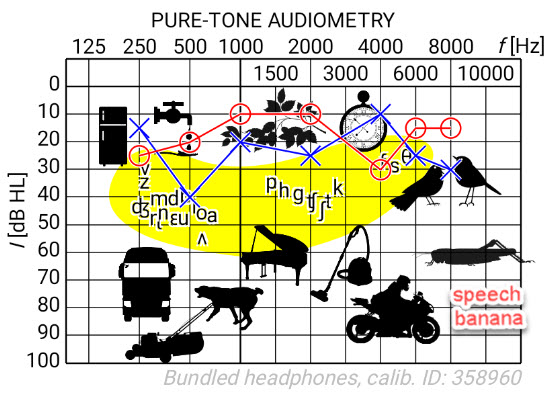
Pure-Audio-Test Are we chaing Volume to test the Hearing Capability?
In PIA test what is the criteria to generate sound?